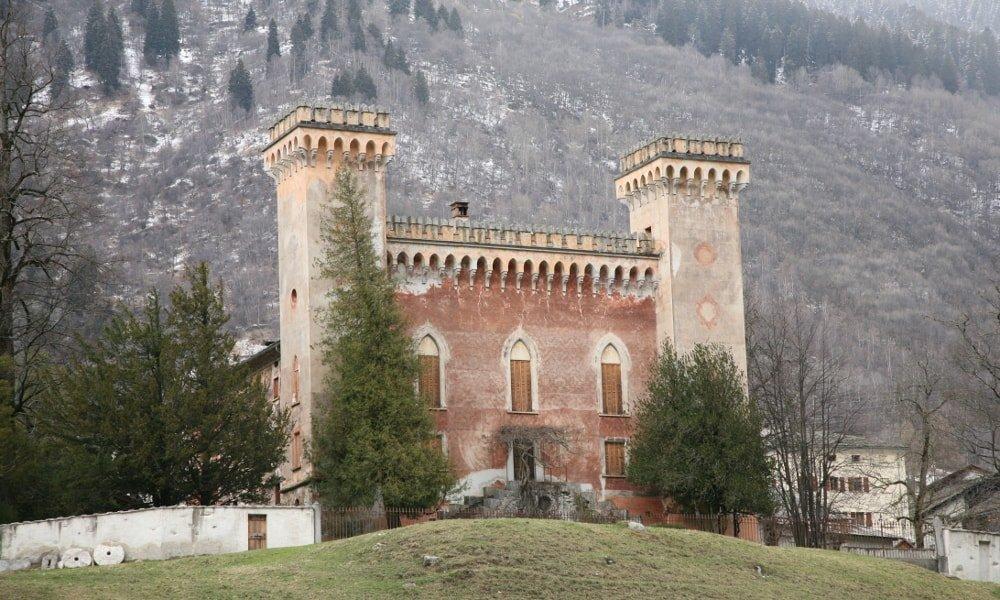
Castelmur Palace
Switzerland
Schloss Lenzburg
Lenzburg Castle is among the oldest and most historic hilltop castles in Switzerland, and for a thousand years it has been caught up in major political and historical events across Europe.
Did You Know
People were already living on this prominent hill in prehistoric times; in 1959 a Neolithic grave was found where the car park is now, and smaller finds date from the Roman and Alemannic periods.
According to legend, a dragon once lived in a cave in the hillside until two knights, Wolfram and Guntram, killed it. In thanks, the people made them Counts of Lenzburg and allowed them to build a castle on the summit.
A charter of 1036 mentions Ulrich, Count of Aargau, who was the Emperor's Vogt in Zürich and protector of the abbeys of Beromünster and Schänis. The castle is first securely documented in 1077, when his grandson, another Ulrich, sided with the emperor in the Investiture Controversy and held two Papal legates prisoner for six months. The Counts of Lenzburg were then among the most powerful lords on the Swiss plateau and stood close to the emperor.
The family died out in 1173. Ulrich IV, the last count, had gone on the Second Crusade with Emperor Friedrich I Barbarossa and made him his personal heir. The emperor travelled to Lenzburg to oversee the division of the estate himself, giving most of the land to his son Otto, Count palatine of Burgundy. After Otto died in 1200, however, the Hohenstaufen had to pull out of the Aargau. Through two neighbouring noble houses, Andechs-Merania and Châlon, the castle passed by marriage to the Counts of Kyburg in about 1230, and they founded a fortified market at the western foot of the hill, the origin of today's town of Lenzburg.
Hartmann, the last Count of Kyburg, died in 1264 with no sons. Rudolph I, Count of Habsburg and later King of the Romans, took the heiress Anna of Kyburg under his protection; she later married Eberhard I of Habsburg-Laufenburg. Rudolph took over the estate from his impoverished relatives in 1273 and held court there in 1275. As Habsburg power moved steadily towards Austria, though, the castle sank to the status of a regional administrative seat. Count Frederick the Fair granted Lenzburg its town charter on 20 August 1306. From 1339 Count Frederick II of Tyrol-Austria lived at the castle. He was meant to marry a daughter of King Edward III of England and had the Knights' Hall built for the occasion, but he died in 1344 without ever meeting his bride, and the hall was left unfinished. The Schultheiss-Ribi family leased the castle from 1369, and in 1375 it was besieged by the Gugler.
Long-simmering tension between Sigismund, King of Germany, and Frederick IV, Duke of Austria, broke out in 1415 at the Council of Constance, when Frederick helped Antipope John XXIII, one of three rival popes at the time, flee the town. Sigismund seized the chance to hurt his rival and called on Frederick's neighbours to take his lands in the name of the Empire. Bern was happy to conquer the western Aargau.
The town of Lenzburg gave itself up to the advancing army on 20 April, while the castle was left alone for the time being. Konrad of Weinsberg, acting for the king, tried to hold it for the Empire and readied it for a siege, but by August he recognised the effort was hopeless, and in 1418 he handed the castle back to the Schultheiss family. After long negotiations Bern obtained the County of Lenzburg as subtenant in 1433 and the castle itself in 1442.
In 1444 the first Bernese Landvogt moved into the castle to govern the Lenzburg district. The office covered tax collection, administration, justice and policing, military orders and the upkeep of the castle, and the holder was chosen from Bern's city council for a four-year term. The most famous Landvogt of Lenzburg was Adrian I of Bubenberg, who served from 1457 to 1461 and later became Schultheiß of Bern and the hero of the Battle of Morat.
Major works took place in 1509–10, including partly demolishing and rebuilding the unfinished Knights' Hall. A serious fire broke out in 1518; it is not known which buildings burned, though the Arburghaus on the north side is the most likely. The Landvogt got a new residence, the Landvogtei, in 1520, and during the Second War of Kappel in 1531 the castle was the Protestants' base of operations.
In 1624 Landvogt Joseph Plepp produced the first accurate drawings and plans of the castle, which then looked more like a fortified farmstead. They became the starting point for turning it into a fortress. In 1625 a double curtain wall and double gatehouse were built on a new line in the northern section, and the earth ramparts on the east and south were raised. Between 1642 and 1646 an eleven-metre wall went up to form the east bastion. Money ran out before the rest could be built, and the bastion had a serious flaw: rain seeped through the neighbouring walls and made the Landvogt's residence too damp to live in. A new residence was therefore built in the northern section between 1672 and 1674.
In the 18th century Bern turned the castle into a huge granary, linking the buildings and partly gutting them to create storage for more than 5,000 tonnes of wheat. In March 1798 Viktor von Wattenwyl, the 71st and final Landvogt, handed the castle over to the advancing French.
The Canton of Aargau was created in 1803 and took ownership of the castle a year later. Unsure what to do with this emblem of the old overlords, the canton could not see it as a government seat, and the building stood empty for almost twenty years. Then Christian Lippe, a teacher working in Hofwil, rented it and in 1822 opened a school run on the principles of Johann Heinrich Pestalozzi. At its height it had 50 pupils and 12 teachers, mostly sons of leading manufacturing families from Basel and Alsace. Classes were held in the Hintere Haus, the rear building, while the teachers lived in the Landvogtei. Lippe fell seriously ill, and the school closed in 1853.
In 1860 the canton sold the castle for 60,000 francs to Konrad Pestalozzi-Scotchburn of Zürich, about whom little is known. Friedrich Wilhelm Wedekind bought it in 1872 for 90,000 francs. After the failed March Revolution of 1849 he had gone to San Francisco and made a fortune in land speculation during the California Gold Rush. He came back to Europe in 1864, then left Germany again in protest at Prussian dominance of the German Empire, settling at the castle in Switzerland. His 6 children, including the singer Erika Wedekind and the writers Frank Wedekind and Donald Wedekind, grew up there.
So that the inheritance could be divided, the Wedekinds sold the castle in 1893 for 120,000 francs to the American industrialist Augustus Edward Jessup. Originally from Philadelphia but long settled in England, he was married to Mildred Marion Bowes-Lyon, an aunt of the Queen Mother, Elizabeth Bowes-Lyon, which linked him by marriage to the British royal family. Jessup had the castle thoroughly restored, removing later additions and military structures to bring it close to its medieval state, filled the rooms with costly furniture and installed central heating, plumbing and electricity, paying the half a million francs himself.
James Ellsworth, another American industrialist and a collector of medieval art, heard that the castle held a table from the time of Friedrich Barbarossa. He wanted it for his collection, but the only way to get it was to buy the whole castle, which he did in 1911 for 550,000 francs. His son, the polar explorer Lincoln Ellsworth, inherited it in 1925 but stayed there only now and then.
When Lincoln Ellsworth died in 1951, the castle went to his widow, Marie Louise Ellsworth-Ulmer. In 1956 she sold it with its contents for 500,000 francs to a foundation formed by the town of Lenzburg and the Canton of Aargau, which allowed it to open to the public. The cultural foundation Stapferhaus Lenzburg was founded in 1960 and moved into the Hintere Haus. Another full renovation followed between 1978 and 1986, along with a French-style garden in the southwest section. In 1987 the canton moved its cultural history collections to the castle and opened the Historisches Museum Aargau (Historical Museum of the Aargau), renamed Museum Aargau (Aargau Museum) in 2007. The exhibitions have been renewed step by step since 2009.
Owners of the castle through the centuries: the Counts of Lenzburg from c. 1000 to 1173; Emperor Barbarossa in 1173; the Counts of Kyburg from 1173 to 1273; the Habsburg dukes and kings from 1273 to 1415; and the City of Bern from 1415 to 1798, with full ownership from 1433 and the Landvogt's seat there from 1444.
Gallery
Videos
Visitor reviews
to leave a review.
B2B Event Inquiry
Planning a wedding, seminar, or corporate gala at Lenzburg Castle? Share your requirements and our team will connect you with the estate.
Step 1 of 3
Event Details
Estate owners
Request ownership to manage photos, details, and event inquiries for Lenzburg Castle.
Continue exploring