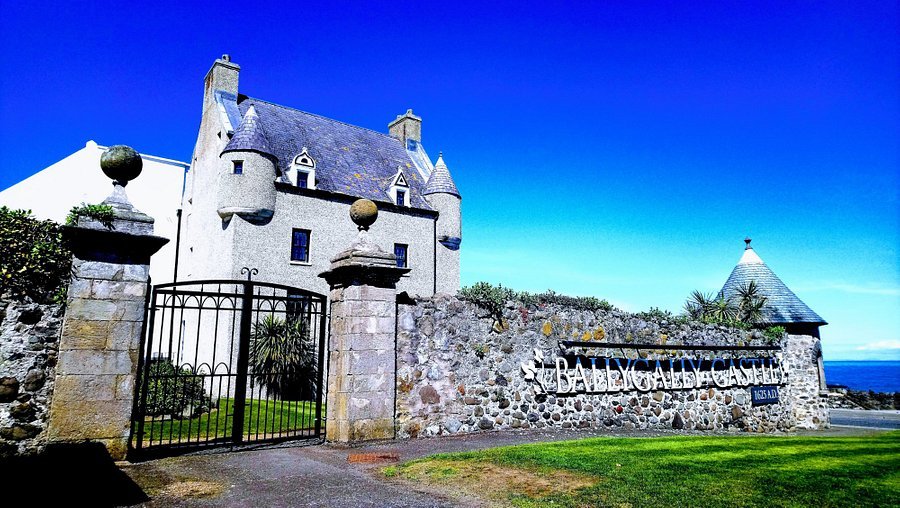
Ballygally Castle
United Kingdom
Windsor Castle
-If the Queen’s at home, you’ll know by the flag-
Did You Know
Windsor Castle is a royal residence at Windsor in the English county of Berkshire. It is strongly associated with the English and succeeding British royal family, and embodies almost 1,000 years of architectural history.
The original castle was built in the 11th century after the Norman invasion of England by William the Conqueror. Since the time of Henry I, it has been used by the reigning monarch and is the longest-occupied palace in Europe. The castle's lavish early 19th-century State Apartments were described by early 20th century art historian Hugh Roberts as "a superb and unrivalled sequence of rooms widely regarded as the finest and most complete expression of later Georgian taste". Inside the castle walls is the 15th-century St George's Chapel, considered by the historian John Martin Robinson to be "one of the supreme achievements of English Perpendicular Gothic" design.
Originally designed to protect Norman dominance around the outskirts of London and oversee a strategically important part of the River Thames, Windsor Castle was built as a motte-and-bailey, with three wards surrounding a central mound. Gradually replaced with stone fortifications, the castle withstood a prolonged siege during the First Barons' War at the start of the 13th century. Henry III built a luxurious royal palace within the castle during the middle of the century, and Edward III went further, rebuilding the palace to make an even grander set of buildings in what would become "the most expensive secular building project of the entire Middle Ages in England". Edward's core design lasted through the Tudor period, during which Henry VIII and Elizabeth I made increasing use of the castle as a royal court and centre for diplomatic entertainment.
Windsor Castle survived the tumultuous period of the English Civil War, when it was used as a military headquarters by Parliamentary forces and a prison for Charles I. At the Restoration of the monarchy in 1660, Charles II rebuilt much of Windsor Castle with the help of the architect Hugh May, creating a set of extravagant Baroque interiors that are still admired. After a period of neglect during the 18th century, George III and George IV renovated and rebuilt Charles II's palace at colossal expense, producing the current design of the State Apartments, full of Rococo, Gothic and Baroque furnishings. Queen Victoria made a few minor changes to the castle, which became the centre for royal entertainment for much of her reign. Windsor Castle was used as a refuge by the royal family during the Luftwaffe bombing campaigns of the Second World War and survived a fire in 1992. It is a popular tourist attraction, a venue for hosting state visits, and the preferred weekend home of Queen Elizabeth II.
11th and 12th centuries
Windsor Castle was originally built by William the Conqueror in the decade after the Norman conquest of 1066. William established a defensive ring of motte and bailey castles around London; each was a day's march – about 20 miles (32 km) – from the city and from the next castle, allowing for easy reinforcements in a crisis. Windsor Castle, one of this ring of fortifications, was strategically important because of its proximity to both the River Thames, a key medieval route into London, and Windsor Forest, a royal hunting preserve previously used by the Saxon kings. The nearby settlement of Clivore, or Clewer, was an old Saxon residence. The initial wooden castle consisted of a keep on the top of a man-made motte, or mound, protected by a small bailey wall, occupying a chalk inlier, or bluff, rising 100 ft (30 m) above the river. A second wooden bailey was constructed to the east of the keep, forming the later Upper Ward. By the end of the century, another bailey had been constructed to the west, creating the basic shape of the modern castle. In design, Windsor most closely resembled Arundel Castle, another powerful early Norman fortification, but the double bailey design was also found at Rockingham and Alnwick Castle.
Windsor was not initially used as a royal residence. The early Norman kings preferred to use the former palace of Edward the Confessor in the village of Old Windsor. The first king to use Windsor Castle as a residence was Henry I, who celebrated Whitsuntide at the castle in 1110 during a period of heightened insecurity. Henry's marriage to Adela, the daughter of Godfrey of Louvain, took place in the castle in 1121. During this period the keep suffered a substantial collapse – archaeological evidence shows that the southern side of the motte subsided by over 6 ft (2 m). Timber piles were driven in to support the motte and the old wooden keep was replaced with a new stone shell keep, with a probable gateway to the north-east and a new stone well. A chemise, or low protective wall, was subsequently added to the keep.
Henry II came to the throne in 1154 and built extensively at Windsor between 1165 and 1179.Henry replaced the wooden palisade surrounding the upper ward with a stone wall interspersed with square towers and built the first King's Gate. The first stone keep was suffering from subsidence, and cracks were beginning to appear in the stonework of the south side. Henry replaced the keep with another stone shell keep and chemise wall, but moved the walls in from the edge of the motte to relieve the pressure on the mound, and added massive foundations along the south side to provide additional support.[84] Inside the castle Henry remodelled the royal accommodation. Bagshot Heath stone was used for most of the work, and stone from Bedfordshire for the internal buildings.
King John undertook some building works at Windsor, but primarily to the accommodation rather than the defences. The castle played a role during the revolt of the English barons: the castle was besieged in 1214, and John used the castle as his base during the negotiations before the signing of the Magna Carta at nearby Runnymede in 1215. In 1216 the castle was besieged again by baronial and French troops under the command of the Count of Nevers, but John's constable, Engelard de Cigogné, successfully defended it.
The damage done to the castle during the second siege was immediately repaired in 1216 and 1221 by Cigogne on behalf of John's successor Henry III, who further strengthened the defences. The walls of the Lower Ward were rebuilt in stone, complete with a gatehouse in the location of the future Henry VIII Gate, between 1224 and 1230. Three new towers, the Curfew, Garter and the Salisbury towers, were constructed. The Middle Ward was heavily reinforced with a southern stone wall, protected by the new Edward III and Henry III towers at each end.
Windsor Castle was one of Henry's three favourite residences and he invested heavily in the royal accommodation, spending more money at Windsor than in any other of his properties. Following his marriage to Eleanor of Provence, Henry built a luxurious palace in 1240–63, based around a court along the north side of the Upper Ward. This was intended primarily for the queen and Henry's children. In the Lower Ward, the king ordered the construction of a range of buildings for his own use along the south wall, including a 70 ft (21 m) long chapel, later called the Lady Chapel. This was the grandest of the numerous chapels built for his own use, and comparable to the Sainte-Chapelle in Paris in size and quality. Henry repaired the Great Hall that lay along the north side of the Lower Ward, and enlarged it with a new kitchen and built a covered walkway between the Hall and the kitchen. Henry's work was characterised by the religious overtones of the rich decorations, which formed "one of the high-water marks of English medieval art".The conversion cost more than £10,000. The result was to create a division in the castle between a more private Upper Ward and a Lower Ward devoted to the public face of the monarchy. Little further building was carried out at the castle during the 13th century; the Great Hall in the Lower Ward was destroyed by fire in 1296, but it was not rebuilt.
Edward III was born at Windsor Castle and used it extensively throughout his reign. In 1344 the king announced the foundation of the new Order of the Round Table at the castle.[6] Edward began to construct a new building in the castle to host this order, but it was never finished. Chroniclers described it as a round building, 200 ft (61 m) across, and it was probably in the centre of the Upper Ward. Shortly afterwards, Edward abandoned the new order for reasons that remain unclear, and instead established the Order of the Garter, again with Windsor Castle as its headquarters, complete with the attendant Poor Knights of Windsor. As part of this process Edward decided to rebuild Windsor Castle, in particular Henry III's palace, in an attempt to construct a castle that would be symbolic of royal power and chivalry. Edward was influenced both by the military successes of his grandfather, Edward I, and by the decline of royal authority under his father, Edward II, and aimed to produce an innovative, "self-consciously aesthetic, muscled, martial architecture".
Edward placed William of Wykeham in overall charge of the rebuilding and design of the new castle and whilst work was ongoing Edward stayed in temporary accommodation in the Round Tower. Between 1350 and 1377 Edward spent £51,000 on renovating Windsor Castle; this was the largest amount spent by any English medieval monarch on a single building operation, and over one and a half times Edward's typical annual income of £30,000. Some of the costs of the castle were paid from the results of ransoms following Edward's victories at the battles of Crécy, Calais and Poitiers. Windsor Castle was already a substantial building before Edward began expanding it, making the investment all the more impressive, and much of the expenditure was lavished on rich furnishings. The castle was "the most expensive secular building project of the entire Middle Ages in England".
Edward's new palace consisted of three courts along the north side of the Upper Ward, called Little Cloister, King's Cloister and the Kitchen Court. At the front of the palace lay the St George's Hall range, which combined a new hall and a new chapel. This range had two symmetrical gatehouses, the Spicerie Gatehouse and the Kitchen Gatehouse. The Spicerie Gatehouse was the main entrance into the palace, whilst the Kitchen Gatehouse simply led into the kitchen courtyard. The great hall had numerous large windows looking out across the ward. The range had an unusual, unified roof-line and, with a taller roof than the rest of the palace, would have been highly distinctive. The Rose Tower, designed for the king's private use, set off the west corner of the range.The result was a "great and apparently architecturally unified palace ... uniform in all sorts of ways, as to roof line, window heights, cornice line, floor and ceiling heights". With the exception of the Hall, Chapel and the Great Chamber, the new interiors all shared a similar height and width. The defensive features, however, were primarily for show, possibly to provide a backdrop for jousting between the two-halves of the Order of the Garter.
Edward built further luxurious, self-contained lodgings for his court around the east and south edges of the Upper Ward, creating the modern shape of the quadrangle. The Norman gate was built to secure the west entrance to the Ward. In the Lower Ward, the chapel was enlarged and remodelled with grand buildings for the canons built alongside. The earliest weight-driven mechanical clock in England was installed by Edward III in the Round Tower in 1354. William of Wykeham went on to build New College, Oxford and Winchester College, where the influence of Windsor Castle can easily be seen.
The new castle was used to hold French prisoners taken at the Battle of Poitiers in 1357, including King John II, who was held for a considerable ransom. Later in the century, the castle also found favour with Richard II. Richard conducted restoration work on St George's Chapel, the work being carried out by Geoffrey Chaucer, who served as a diplomat and Clerk of The King's Works.
Windsor Castle continued to be favoured by monarchs in the 15th century, despite England beginning to slip into increasing political violence. Henry IV seized the castle during his coup in 1399, although failing to catch Richard II, who had escaped to London. Under Henry V, the castle hosted a visit from the Holy Roman Emperor in 1417, a massive diplomatic event that stretched the accommodation of the castle to its limits.
By the middle of the 15th century England was increasingly divided between the rival royal factions of the Lancastrians and the Yorkists. Castles such as Windsor did not play a decisive role during the resulting Wars of the Roses (1455–85), which were fought primarily in the form of pitched battles between the rival factions. Henry VI, born at Windsor Castle and known as Henry of Windsor, became king at the young age of nine months. His long period of minority, coupled with the increasing tensions between Henry's Lancastrian supporters and the Yorkists, distracted attention from Windsor. The Garter Feasts and other ceremonial activities at the castle became more infrequent and less well attended.
Edward IV seized power in 1461. When Edward captured Henry's wife, Margaret of Anjou, she was brought back to be detained at the castle. Edward began to revive the Order of the Garter, and held a particularly lavish feast in 1472. Edward began the construction of the present St. George's Chapel in 1475, resulting in the dismantling of several of the older buildings in the Lower Ward. By building the grand chapel Edward was seeking to show that his new dynasty were the permanent rulers of England, and may also have been attempting to deliberately rival the similar chapel that Henry VI had ordered to be constructed at nearby Eton College. Richard III made only a brief use of Windsor Castle before his defeat at the Battle of Bosworth Field in 1485, but had the body of Henry VI moved from Chertsey Abbey in Surrey to the castle to allow it to be visited by pilgrims more easily.
Henry VII made more use of Windsor. In 1488, shortly after succeeding to the throne, he held a massive feast for the Order of the Garter at the castle. He completed the roof of St George's Chapel, and set about converting the older eastern Lady Chapel into a proposed shrine to Henry VI, whose canonisation was then considered imminent. In the event, Henry VI was not canonised and the project was abandoned, although the shrine continued to attract a flood of pilgrims. Henry VII appears to have remodelled the King's Chamber in the palace, and had the roof of the Great Kitchen rebuilt in 1489. He also built a three-storied tower on the west end of the palace, which he used for his personal apartments. Windsor began to be used for international diplomatic events, including the grand visit of Philip I of Castile in 1506. William de la Pole, one of the surviving Yorkist claimants to the throne, was imprisoned at Windsor Castle during Henry's reign, before his execution in 1513.
Henry VIII enjoyed Windsor Castle, as a young man "exercising himself daily in shooting, singing, dancing, wrestling, casting of the bar, playing at the recorders, flute, virginals, in setting of songs and making of ballads". The tradition of the Garter Feasts was maintained and became more extravagant; the size of the royal retinue visiting Windsor had to be restricted because of the growing numbers. During the Pilgrimage of Grace, a huge uprising in the north of England against Henry's rule in 1536, the king used Windsor as a secure base in the south from which to manage his military response. Throughout the Tudor period, Windsor was also used as a safe retreat in the event of plagues occurring in London.
Henry rebuilt the principal castle gateway in about 1510 and constructed a tennis court at the base of the motte in the Upper Ward. He also built a long terrace, called the North Wharf, along the outside wall of the Upper Ward; constructed of wood, it was designed to provide a commanding view of the River Thames below. The design included an outside staircase into the king's apartments, which made the monarch's life more comfortable at the expense of considerably weakening the castle's defences.[126] Early in his reign, Henry had given the eastern Lady Chapel to Cardinal Wolsey for Wolsey's future mausoleum. Benedetto Grazzini converted much of this into an Italian Renaissance design, before Wolsey's fall from power brought an end to the project, with contemporaries estimating that around £60,000 (£295 million in 2008 terms) had been spent on the work. Henry continued the project, but it remained unfinished when he himself was buried in the chapel, in an elaborate funeral in 1547.
By contrast, the young Edward VI disliked Windsor Castle. Edward's Protestant beliefs led him to simplify the Garter ceremonies, to discontinue the annual Feast of the Garter at Windsor and to remove any signs of Catholic practices with the Order. During the rebellions and political strife of 1549, Windsor was again used as a safe-haven for the king and the Duke of Somerset. Edward famously commented whilst staying at Windsor Castle during this period that "Methink I am in a prison, here are no galleries, nor no gardens to walk in". Under both Edward and his sister, Mary I, some limited building work continued at the castle, in many cases using resources recovered from the English abbeys. Water was piped into the Upper Ward to create a fountain. Mary also expanded the buildings used by the Knights of Windsor in the Lower Ward, using stone from Reading Abbey.
Elizabeth I spent much of her time at Windsor Castle and used it a safe haven in crises, "knowing it could stand a siege if need be". Ten new brass cannons were purchased for the castle's defence.It became one of her favourite locations and she spent more money on the property than on any of her other palaces. She conducted some modest building works at Windsor, including a wide range of repairs to the existing structures. She converted the North Wharf into a permanent, huge stone terrace, complete with statues, carvings and an octagonal, outdoor banqueting house, raising the western end of the terrace to provide more privacy. The chapel was refitted with stalls, a gallery and a new ceiling. A bridge was built over the ditch to the south of the castle to enable easier access to the park.[136] Elizabeth built a gallery range of buildings on the west end of the Upper Ward, alongside Henry VII's tower. Elizabeth increasingly used the castle for diplomatic engagements, but space continued to prove a challenge as the property was simply not as large as the more modern royal palaces. This flow of foreign visitors was captured for the queen's entertainment in William Shakespeare's play, The Merry Wives of Windsor.
Estate Details
Location
Royal Windsor Information Centre, Windsor Royal Station SL4 1PJ Windsor, UK
Castle type
Castle
Architecture
Gothic, Rococo, Baroque
Construction
1165
Region
Royal Borough of Windsor and Maidenhead
Links
Gallery
B2B Event Inquiry
Planning a wedding, seminar, or corporate gala at Windsor Castle? Share your requirements and our team will connect you with the estate.
Step 1 of 3
Event Details
Location
Royal Windsor Information Centre, Windsor Royal Station SL4 1PJ Windsor, UK
Estate owners
Request ownership to manage photos, details, and event inquiries for Windsor Castle.
Continue exploring