

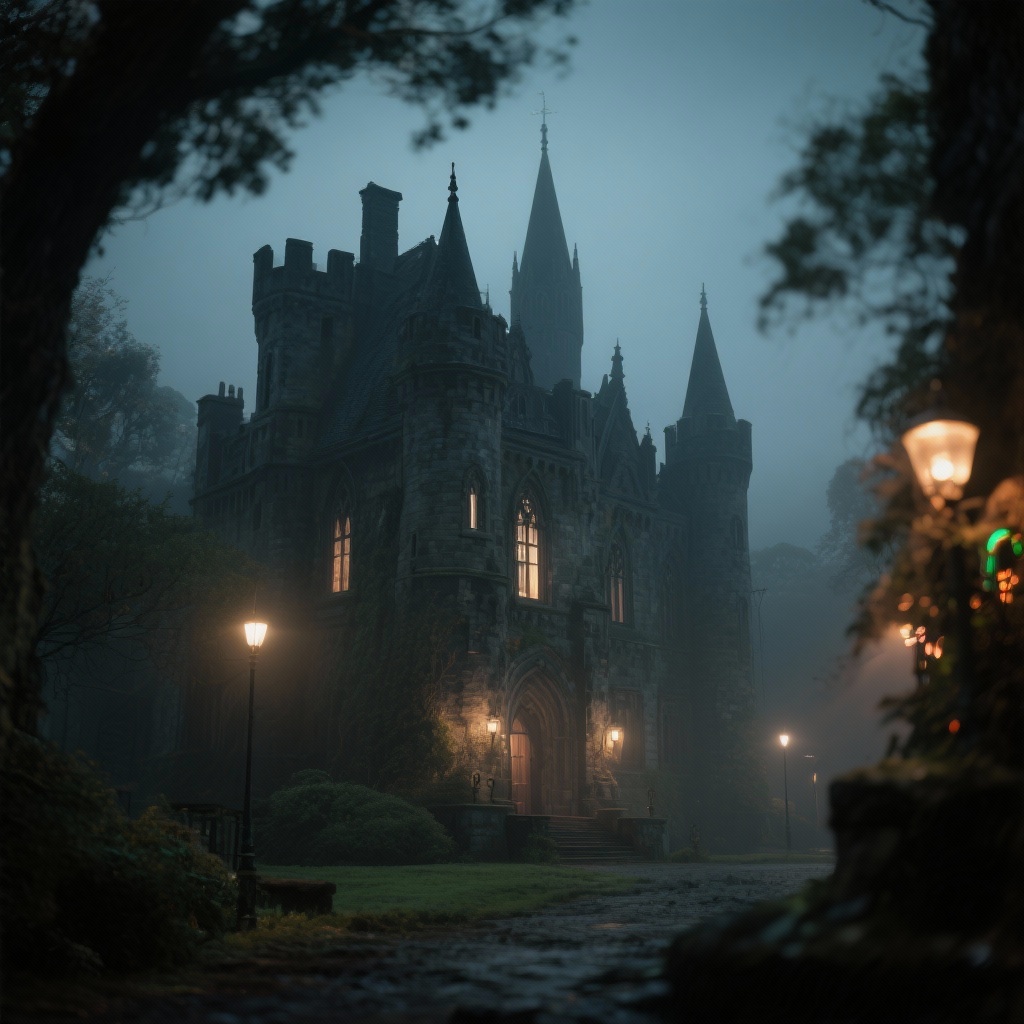
In the aftermath of Europe’s restless Middle Ages, stone became both weapon and witness
Castles were not raised only to guard land, but to express belonging — physical proof of endurance and faith. Their outlines marked the horizon like signatures, written in granite and limestone. Over the centuries, those rough silhouettes softened, turned upward, and began to resemble prayer more than protection. The Gothic age had arrived, and with it a new idea: that beauty itself could fortify the soul.
Long before pointed arches and painted glass, Europe’s castles were blunt and hurried things. A lord in need of safety would build a motte-and-bailey fortress — a mound of earth crowned with a timber tower and ringed by a ditch. Smoke, mud, the smell of horses. These early strongholds were born from fear, not from vision. Yet each wooden wall carried a dream of permanence. When the first stones replaced timber, something changed in the collective mind. To build in stone was to declare, I am still here.
The twelfth century brought a deep breath of confidence
Trade routes opened, crusaders returned, and knowledge began to flow like light through a cracked door. The Romanesque style, heavy and rounded, started to stretch upward. Builders learned to play with balance — to let weight rest not on sheer thickness, but on rhythm and geometry. Out of this quiet experiment came the Gothic.
You can sense the difference immediately
The castles of that period no longer cling to the ground; they seem to lean toward the sky. Arches sharpen, towers lengthen, and daylight slips inside where darkness once lived. What had been practical becomes poetic. Even the shadows feel choreographed. You stand in a hall of stone and realize you’re standing inside a thought — the thought that the human spirit could rise, if only it built high enough.
Not every fortress transformed overnight
Some remained grim and squat, especially along the coasts and frontiers. But inland, where peace lasted longer, ambition replaced anxiety. Castles became mirrors of prestige. The hall grew larger, the courtyard wider, the windows taller. A nobleman’s home was now part theater, part sanctuary. When visitors crossed the drawbridge, they were meant to be impressed, not intimidated. The moat was still there, yes, but it reflected banners and sunlight more often than enemy faces.
I remember visiting one such castle on a summer afternoon
Peacocks wandered between the hedges, completely at ease. A century ago those same grounds would have smelled of iron and smoke. Now they smelled of grass and dust warmed by the sun. The transformation from fortress to residence was complete — not just architectural, but emotional. The walls were still strong, but they guarded gentleness.
The Gothic style thrived because it spoke two languages at once
To the eye, it promised elegance and aspiration. To the heart, it whispered safety. Architects borrowed techniques from cathedrals — the pointed arch, the ribbed vault, the flying buttress — but used them in quieter ways. A castle’s chapel might open toward heaven while its keep still watched the road. Each addition balanced faith with caution, devotion with defense.
By the fourteenth century, castles had become living chronicles
They recorded generations like pages in stone. Children were baptized in the same rooms where their ancestors had plotted wars. Banquets celebrated victories long forgotten. When sunlight hit the stained glass, faces from the past seemed to flicker back for a moment. It’s strange, standing in those halls today. You feel surrounded by lives that never completely left.
The later Gothic era refined that feeling into something almost introspective. Instead of simple fortresses or showy palaces, builders created spaces that felt contemplative. The geometry became delicate, sometimes fragile. Ornament turned inward — carvings of vines, saints, and symbols hidden where only the household might notice. Power no longer needed to shout. It could hum quietly through proportion and grace.
And yet, beneath all that beauty, there was always a trace of melancholy. Perhaps people sensed that their golden age would fade. Gunpowder had already begun to make stone walls obsolete. Monarchs looked toward centralized courts rather than isolated castles. The Gothic dream — this fusion of protection and poetry — was living its final chapter. But it went out gently, not in ruin. The last great Gothic castles were elegies in stone, built less for battle than for memory.
Even now, their presence feels personal
Walk across a drawbridge in France or Germany and listen. The sound changes beneath your feet — hollow, wooden, alive. Birds nest in arrow slits; ivy curls through broken windows. What once kept danger out now lets the wind in. The walls do not mourn the change. They adapt, just as they always have.
People often call Gothic architecture dark, but it is really the opposite — an architecture of light and hope. It taught Europe to see space as sacred, to value the upward pull of spirit over the heaviness of fear. In castles, that lesson took on a human scale. Every pointed tower was a declaration that safety could coexist with beauty, that faith could live inside the ordinary rhythms of home.
Standing before one today, you realize how little the world has changed. We still build walls and call them safety. We still chase light through the cracks. The difference is that the Gothic builders knew both instincts were part of the same need — the wish to endure.
The Gothic castle was never merely a building
It was an idea made visible. Its evolution tells us as much about human nature as it does about history — our longing for shelter, for grace, for something that lasts beyond us. The stones are weathered, yes, but the idea remains clear. Even in an age of walls, humanity kept looking upward.