Baranów Sandomierski Castle Zamek w Baranowie Sandomierskim
DID YOU KNOW THAT ...
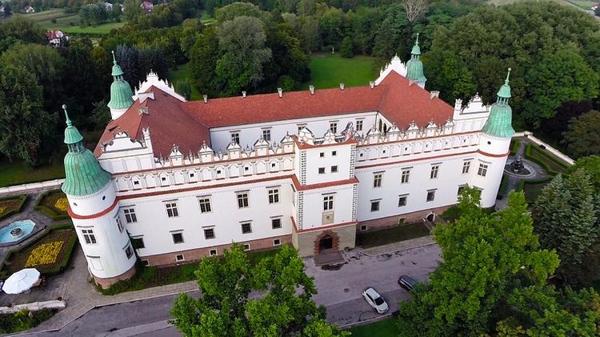
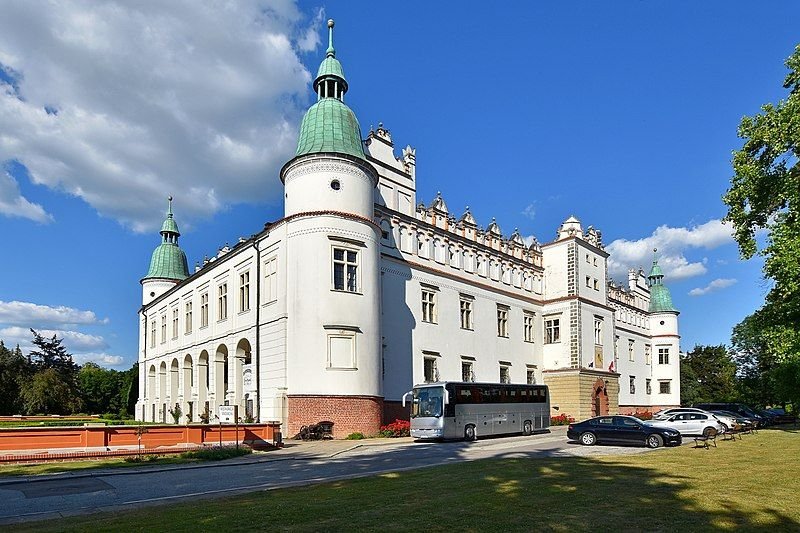
This impressive Renaissance building is one of the best preserved in EuropeThis impressive Renaissance building is one of the best preserved in Europe
The first residential and defensive stronghold was supposed to be built in Baranów as early as the 12th century from the Jaksa foundation, who in 1135 was to erect an unknown timber stronghold on the order of Bolesław III Wrymouth. It was located in the vicinity of the ferry on the Vistula River, several hundred meters away from the Baranów. This is evidenced by the names of the neighboring villages: Przewóz and Przewoźnik, located on both sides of the river. The ferry near Baranów was particularly important because it connected trade routes running from the west from Kraków to the east towards Przemyśl with roads leading from the north from Sandomierz to the south, towards the Hungarian border. The name Baranów probably derives from the breeding of rams, which was then carried out by the inhabitants of this settlement, using the lush Vistula meadows for grazing.
The village of Baranów appears several times in written documents from the 13th and 14th centuries. Among others in 1266, the widow of Baran from Pełczyska sold Baranów for 15 fines of silver to Salomea, sister of Bolesław the Chaste, and in 1354 King Casimir the Great donated Baranów goods to a certain Pietrasz from Małachów and established a fair in the settlement. In 1376, the castle, or rather a wooden stronghold, was to burn down during the Lithuanian raid. The construction of a stone residential and defensive tower probably took place in the 15th century. The chronicler Jan Długosz mentioned that it belonged to the Baranowski family of the Grzymała coat of arms.
Around 1569 medieval building was pulled down by one of the subsequent owners – Rafał Leszczyński. It erected a renaissance defensive court, now embedded in the west wing of the palace, which has survived to our times. The extension of the court took place in the years 1591-1606 according to the design of Santi Gucci, at the time when the owner was the voivode of Brzeg-Kujawy, Andrzej Leszczyński. In this form, the palace happily survived the period of the Swedish invasion in 1655. Another expansion was carried out around 1695 according to the design of Tylman of Gameren, replacing the interior design, crowning the corner towers and introducing bastion fortifications, which replaced the older curtain walls. However, at the end of the 18th century, the Baranów fortifications lost importance, and were demolished in the first half of the 19th century.
The oldest, medieval castle took the form of a stone residential and defensive tower. The thickness of its walls ranged from only 70 cm to 1.2 meters. They were built of gray unworked sandstone of various sizes and a smaller number of bricks, tightly connected with lime mortar. It is uncertain whether the building was made entirely of stone, or whether wood was also used, from which higher storeys may have been erected. The bricks were probably used during later renovation. No traces of plaster were found.
It cannot be ruled out that the tower was built on an artificial mound due to the proximity of two rivers, but also because of the better terrain observation. This type of mound was made of earth coming from the ditch, surrounding the building. After the top yard had been built up and its slopes strengthened, it was left for some time to let the earth settle. It was necessary when the buildings were erected directly on the mound’s top. Then a bridge or a dyke was built, thus allowing easy access to the upper yard. The object itself was fortified with an earth rampart and a palisade. Economic buildings were gathered at the base of the mound, around it.
The tower probably consisted of several floors. On the ground floor in this type of buildings there were utility rooms, above there were residential and representative chambers. It is not certain whether the Baranów tower had three floors, but it is likely. The last one probably was made of wood or half-timbered. Individual rooms were probably covered with flat, wooden ceilings. Medieval residential towers were covered with gable or hip roofs. The height of such a building could reach up to about 20 meters. Only two chambers can be reconstructed from the relics of the building. One of them is a corridor with a length of about 6 meters and a width of 1.75 meters, ended in the eastern part with a wall in which there is a narrowing, which remains after the jamb. The dimensions of the second room are difficult to determine due to damages.
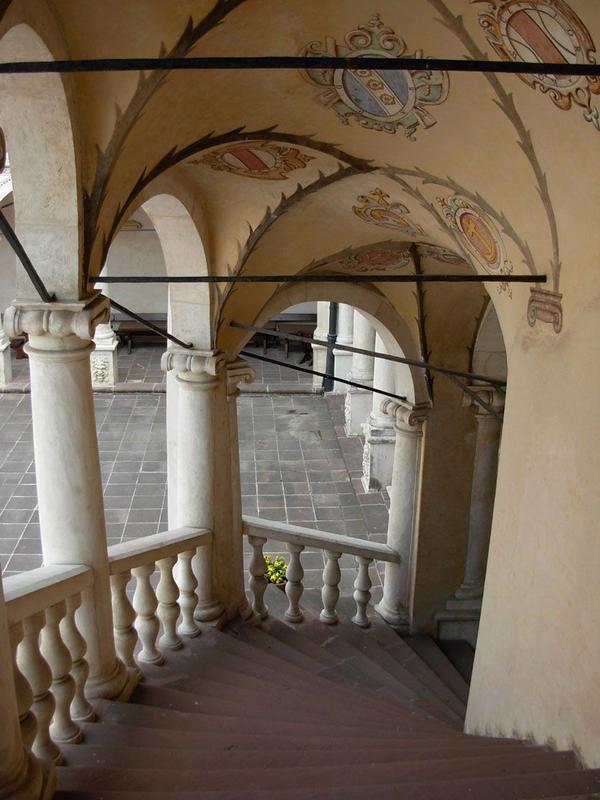
The renaissance fortified manor was built on a rectangular plan and had two or four alcove towers located in the corners. During the rebuilding from the end of the 16th century, the beginning of the 17th century, northern and eastern wings were added to the existing castle, closing the courtyard with a wall and an avant-corps from the south. The eastern wing was supplemented with corner towers for regularity, and the interior was surrounded by cloisters. The outer bailey was also reinforced by curtain wall.
It serves as a historical museum, hotel and conference centre.

- Zamkowa 22, 39-450 Baranów Sandomierski, Poland, Poland